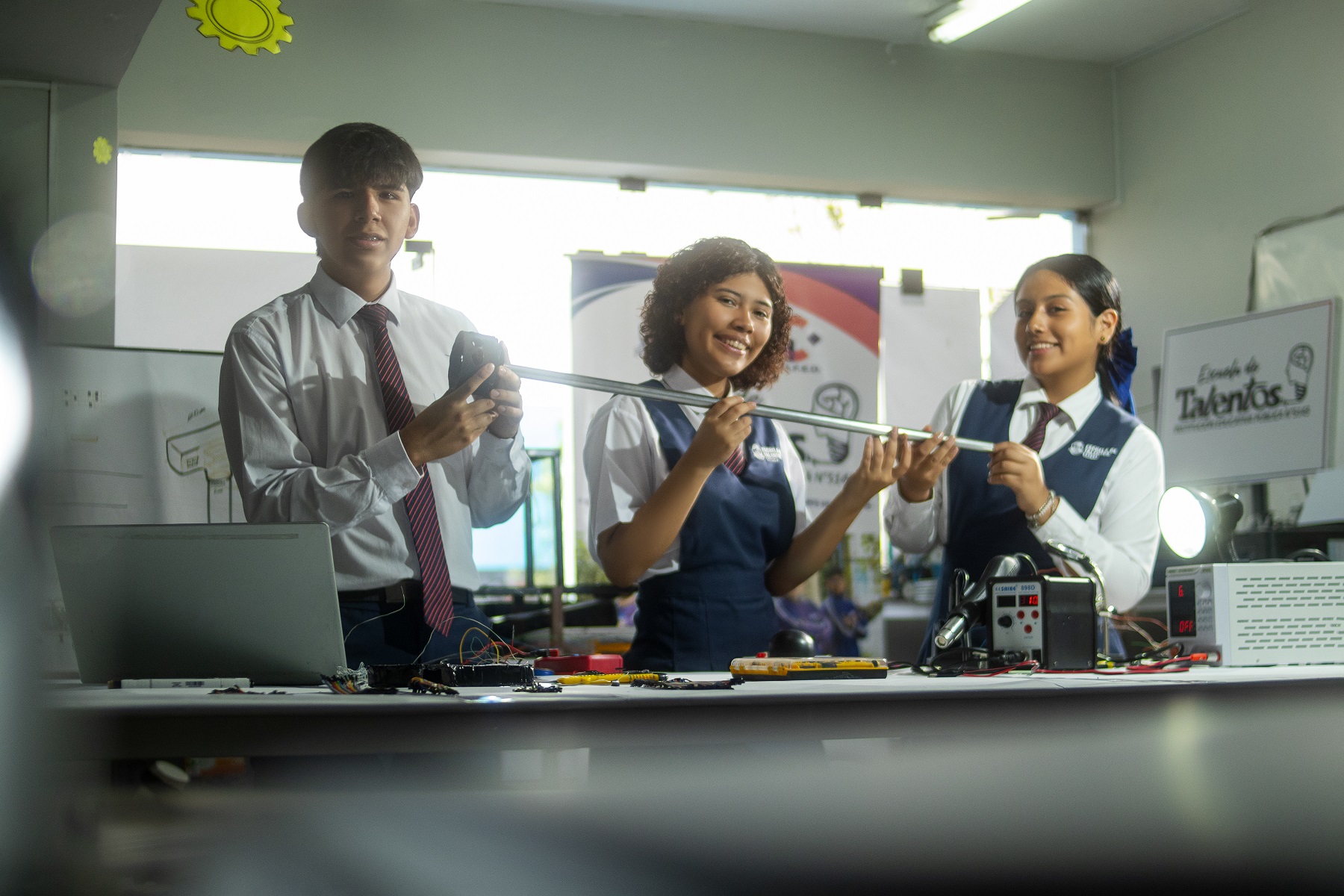
It is not unusual to come across STEM (Science, Technology, Engineering and Mathematics) projects that develop solutions for inclusion and accessibility, that take into account the challenges faced by people with disabilities. Among the finalists and winners of the Solve for Tomorrow projects are walking sticks that identify obstacles, apps that teach pounds and intelligent prosthetics , which reveal the empathic willingness of young people to solve problems in their own environment.
For Doug Alvoroçado, a professor and consultant in education and technology, it is this harmony between technology and an attentive look at reality that makes the STEM field such fertile ground for inclusive initiatives. “STEM projects aim to solve real-life problems, not imaginary or hermetic ones. Inclusion and accessibility are real-life issues, and STEM subjects play a key role in terms of looking at things from a different angle, taking the approach that if society is not yet inclusive for people with disabilities, that technology offers the tools to get there.”
The inclusive approach taken by students from Peru to the challenge of enabling blind people to move through urban spaces was the starting point for the Pusaqkuna project, one of the Solve for Tomorrow finalists in 2024. Since the school is located close to two hospitals, the students realized that uneven sidewalks and other obstacles made it difficult for people with visual impairments to enter and exit the buildings. They then created intelligent canes for blind people that alert the users regarding possible obstacles which help them to move around safely.
The Pusaqkuna project and other inclusive initiatives are often the result of empathy. For the educator Doug Alvoroçado the strategy required to develop this soft skill, which is the initial basis of STEM projects, is a dual challenge: firstly the need to encourage students to put themselves in place of others, prospecting challenges and potentialities taking the concept of being different into account, and secondly to invite them to think about disability as a type of knowledge and an alternative way of interpreting the world.
“The more diverse the group, the more skill and expertise it has. A group with four people who are equal can create something cool. But when the same group has four different people, people with disabilities, different ethnicities and who come from diverse territories, that is a real plus, an advantage. They bring their different realities to bear when thinking about these solutions”, he says.
Having the perspective of a person with disabilities made all the difference in the development of the JENNI “My Physio Friend” project, which was one of the finalists in the 2024 edition of Solve for Tomorrow Mexico. The rehabilitation challenge faced by people with prosthetics, which was the case of this student, drove the group to create a game with artificial intelligence that would help the person to undergo the various phases of rehabilitation in a progressive and playful way.
In the end, in the opinion of this educator, the greatest strategy for encouraging an inclusive approach within STEM projects is a non-negotiable commitment to the inclusion of people with disabilities within educational spaces and in project development. “People with disabilities need to know that technology spaces are there for them, they need to be at the center of the conversation and they need to be invited in an insistent way. ‘Nothing about us without us’ has to be the motto . If I do a project that addresses issues of visual impairment, the development has to include a blind person, providing another perspective. If it is a communication project, even if it is not about disability, you have to have someone who knows sign language, because that adds depth and complexity to the solution.”