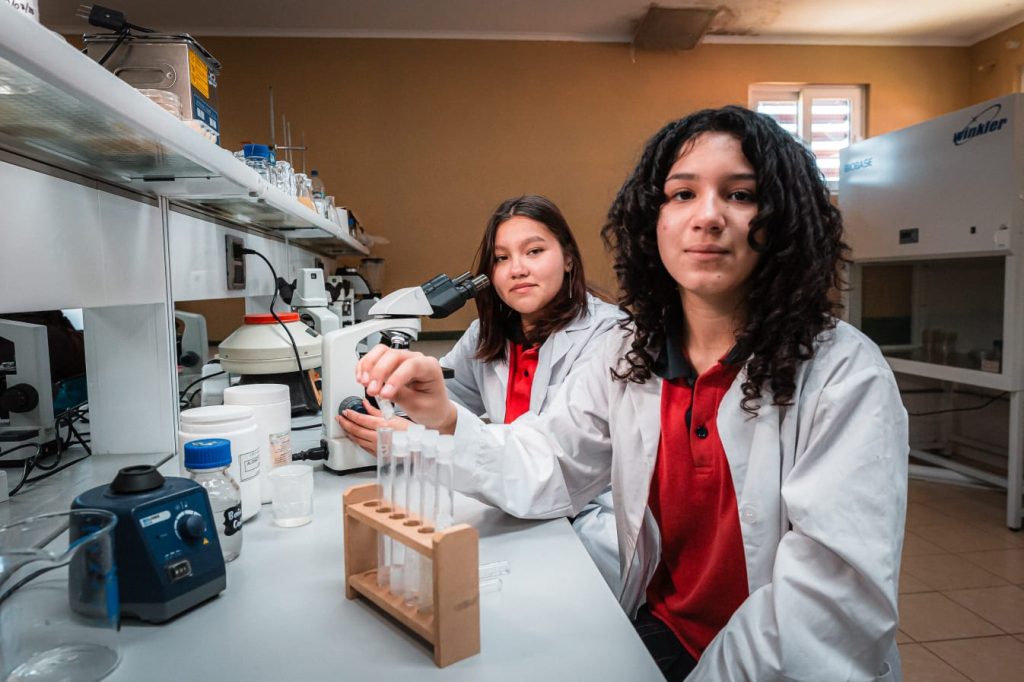
In the face of drought, frost and soil degradation affecting small farmers in central Chile, two Chilean students developed “Fixaterra”, a sustainable biofertilizer made from a naturally occurring bacterium that promotes plant growth and increases plants’ resilience to climate stress. What started as school research ended up becoming the country’s winning Solve for Tomorrow project in 2025.
The two girls were 14 years old and in their second year of high school (the penultimate year of compulsory schooling). The idea was born when they observed the difficulties faced by small farmers in their community due to frost, droughts and soil degradation. In a commune where about 50% of the population lives from family farming, the students wanted to find a way to protect crops from the effects of climate change. “Most farmers rely on controlled release NPK fertilizers. The problem is that these products are coated with synthetic polymers derived from petroleum, which contaminate the soil and degrade aquatic ecosystems,’ explains the mediator teacher Macarena Álvarez.
To solve this problem, they initially thought of developing genetically more resistant plants, but the teacher warned that it was necessary to turn that proposal into a viable solution for a school laboratory. “When it comes to thinking about ideas, it’s encouraging to see students dreaming of launching a satellite into space, but as teachers we have to guide them and turn that idea into something feasible,” says Álvarez.
Thus, they began research on species able to withstand extreme conditions until they found in the scientific literature the potential of Rhizobium, a bacterium that lives naturally in the soil and establishes a mutually beneficial relationship with leguminous plants. When a seed germinates, its roots release substances that attract these bacteria. Once they reach the root, they form an biological association in which the plant provides them with shelter and food, while the bacteria capture the nitrogen present in the air and transform it into a nutrient that the plant can absorb to grow, reducing the need for chemical fertilizers.
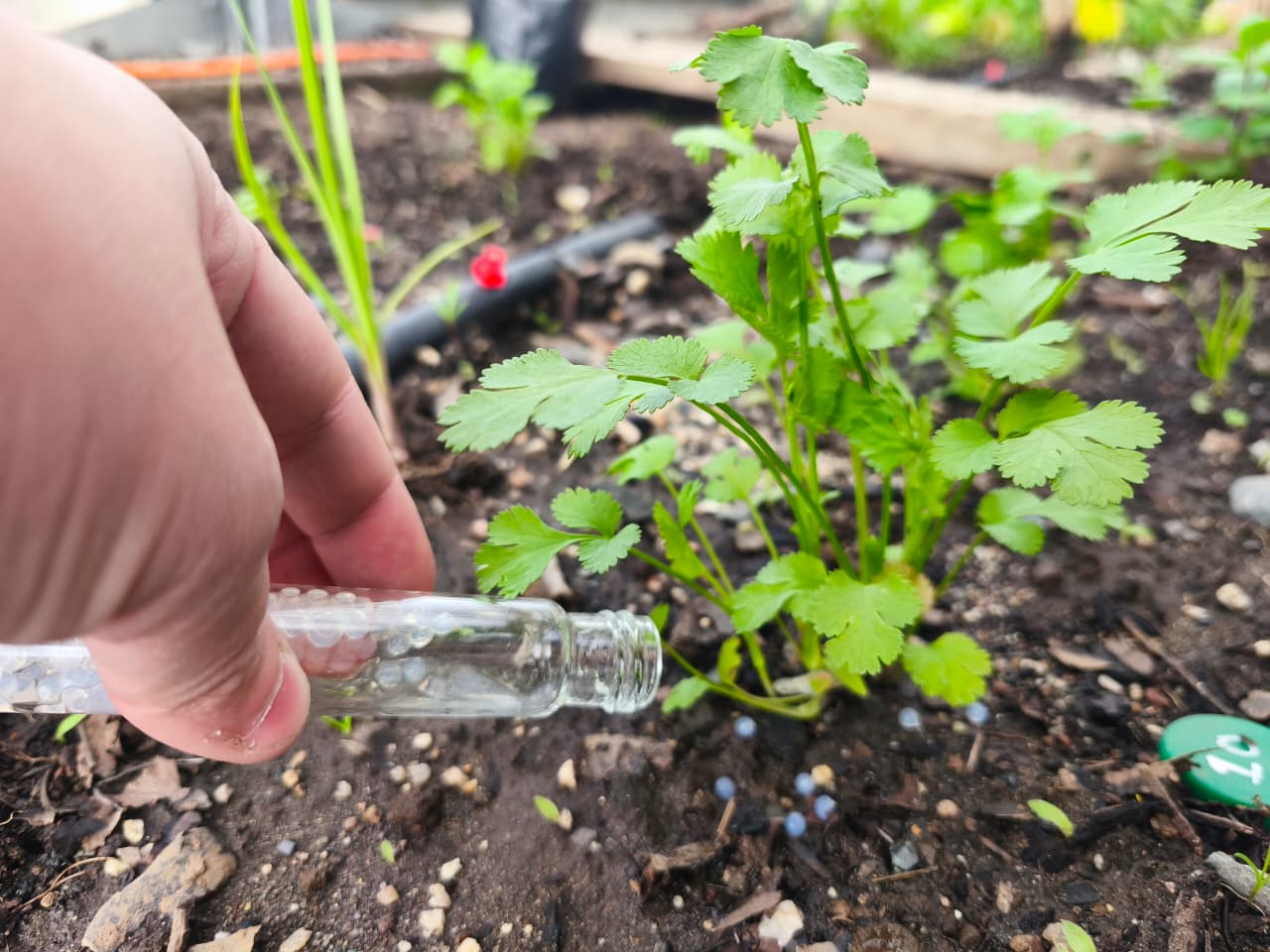
Initially, the students worked directly with roots containing the bacteria, performing small laboratory tests to observe their behavior. Then, trials began with different plant species, especially coriander, which became the main crop because it germinated quickly, was widely used by local farmers and allowed easy measurement of variables such as leaf numbers, root length and growth rate.
With the support of another teacher from the establishment specializing in chemistry, they managed to make the first capsules, manually. The result exceeded expectations: bacteria could be kept alive within small biodegradable spheres, using a source of sugar as a nutrient, until they were incorporated into the soil.
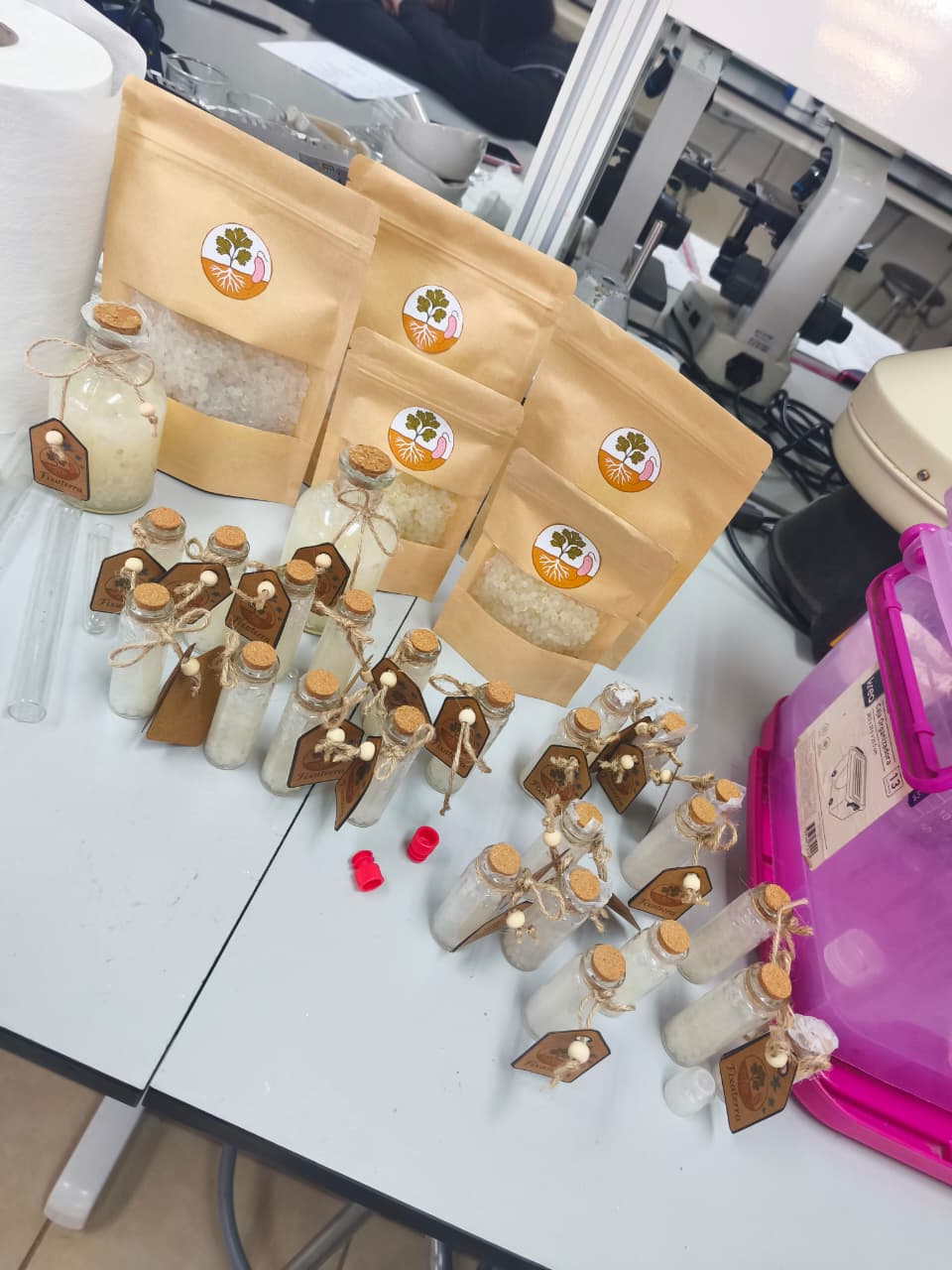
Thus was born the definitive format of “Fixaterra”, a line of biodegradable fertilizers designed to strengthen plant growth, increase their resistance against extreme weather conditions and contribute to soil regeneration, without leaving plastic waste or chemicals.
The product consists of two types of complementary microcapsules. The first type, of soft texture, contains sucrose and the bacteria Rhizobium, a microorganism naturally present in the roots of legumes that has the ability to fix nitrogen from the air and transform it into essential nutrients for plants. The latter provide minerals such as phosphorus and potassium, fundamental for plant development. Both microcapsules are made using an alginate matrix, a biodegradable material that allows for slow and controlled release of its components into the soil.
During the tests carried out by the students, the seeds treated with “Fixaterra” germinated earlier and developed larger and more vigorous cotyledons, indicating better nutrient absorption. In addition to its environmental benefits, the creators highlight that it is a low-cost solution with potential to scale production and benefit more farmers.
Learn by researching, mislearning, and improving
The transition between laboratory and field was one of the most delicate moments in the project, because they moved from a controlled laboratory environment to real cultivation conditions. “We couldn’t deliver a product to the farmers without evidence. They said to us: “You can make mistakes in the laboratory, we cannot make mistakes with our crops,” recalls the educator.
As a result, field trials were conducted gradually, through small-scale trials involving five farmers in the community. Beyond validating the functioning of the biofertilizer in real conditions, this stage allowed students to understand the importance of listening to users, collecting feedback and continuously improving the solution before thinking about a larger-scale application. Prior to the national finals of Solve for Tomorrow, the team had tested around 50 plants, as well as pilot experiments with five local farmers.
The entire development of “Fixaterra” lasted for about a year. Far from seeking an immediate solution, the students were perfecting the project continuously, performing new tests and adjustments at roughly three-month intervals as proposed by the Project Based Learning methodology. Each result opened new questions and each difficulty gave rise to an improvement.
When students learn to research, they are then able to learn anything, the teacher points out.
“Students begin searching for scientific articles, reading research papers, questioning sources, and making evidence-based decisions,” she adds. Although the project had a strong scientific foundation, it still lacked one important step: to transform it into a solution that could be understood by anyone. “The mentorship from Solve for Tomorrow helped a lot. We always saw it as research. They helped us turn it into a product,” she said.
From these conversations new questions arose: How to present the solution? How to explain its operation without using too much technicality? How to make a farmer want to test it?
The students then began to develop a complete visual identity for “Fixaterra”: they designed the name, label, packaging, labeling, promotional materials and even small biodegradable envelopes with coriander seeds to be delivered during the final presentation. We cared for every detail so that it looked like a product ready to go to market. We did everything ourselves,” the teacher emphasizes.
An experience that transformed the students
The educator asserts that the biggest result of the project were not the capsules, but the transformation of the students themselves. “One of the students barely spoke before the project. One minute before he took the stage, he said to me, ‘Teacher, I forgot everything.’ I replied, ‘No, you know everything.’ After the presentation, I saw her giving interviews with an impressive confidence”, notes Álvarez. The other student also discovered new ways to lead teams, dialogue with specialists and publicly defend a scientific proposal. Weeks later, both participated in another school agronomy conference and won second place. After Solve for Tomorrow, any presentation seemed easy to them,’ she says.
For the teacher, this experience was even more special because she had a 100% female team, especially in a context where only 35% of students – worldwide – enrolled in careers in these areas in higher education are women, according to 2017 data from the United Nations Educational, Scientific and Cultural Organization (UNESCO). “Being a woman and a science teacher is looking at them and knowing that I don’t just teach them chemistry or biology, I give them keys to open doors that we were once told weren’t for us,” she recounts.
When research is part of learning
The project was also made possible by a school culture that has been promoting research for several years. The school has a consolidated STEM (Science, Technology, Engineering and Mathematics) program in which different teachers simultaneously guide projects developed by teams of students.
“I am not the only teacher who does projects. We are a team of ten teachers who support research in different areas. This year, for example, I am guiding twelve projects at the same time,” reports Álvarez. Instead of traditional classes, students work autonomously, research, make decisions, and learn how to solve real problems.”
The recognition of “Fixaterra” in Solve for Tomorrow sparked interest from other students, families, media and farmers in the region. “Now many students want to enter the STEM program because they saw that doing science from school is possible,” she says.
Currently the students continue refining the prototype and develop new trials with 200 plants of coriander, which will allow to compare results in conditions closer to the agricultural reality and analyze with greater precision the differences between experiments carried out in laboratory and those developed directly in field. “We keep improving the project. Now we are doing a much larger study to get even more solid evidence,” she explains.
Learn more about the project in the video below: