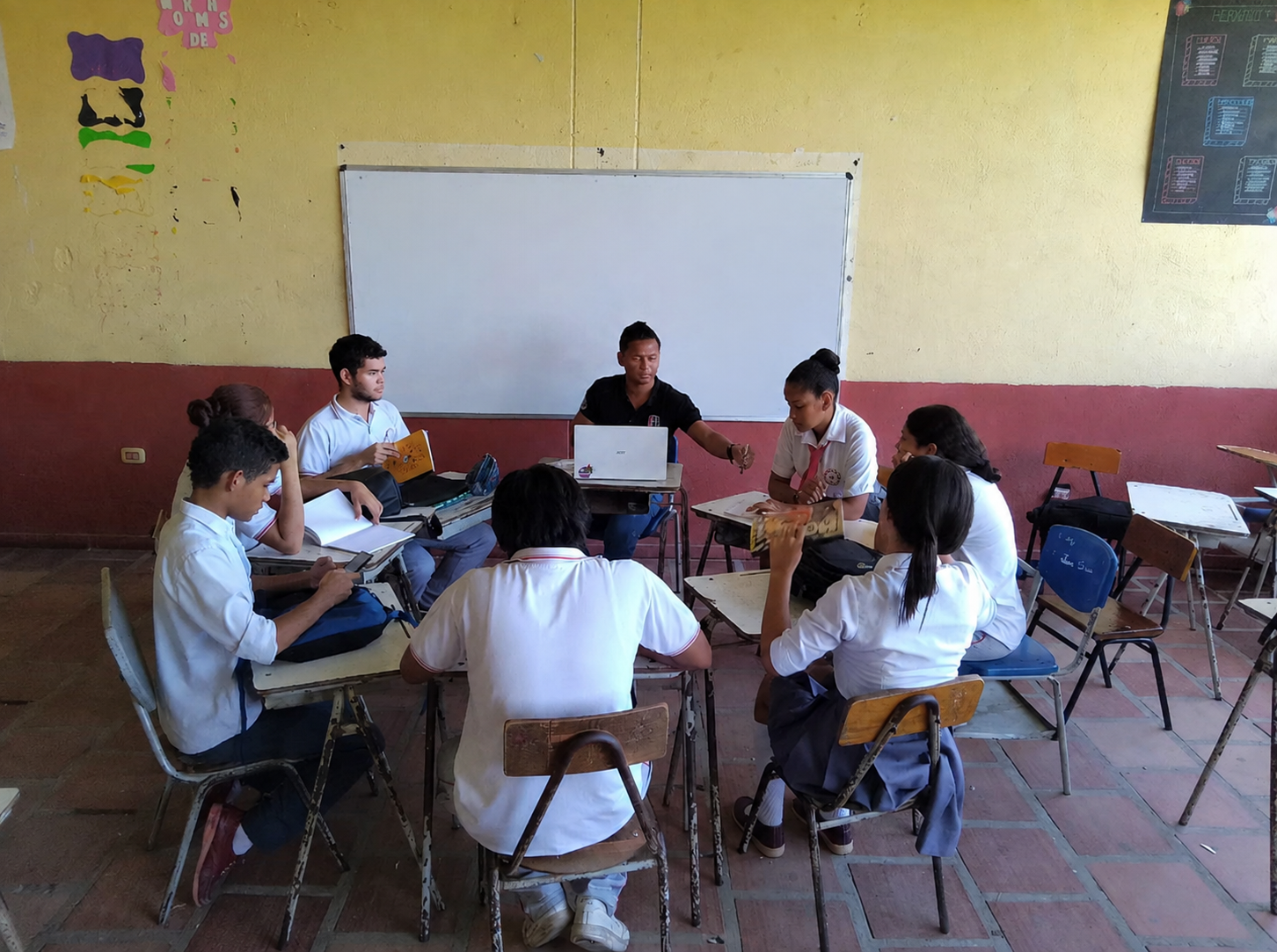
When students closely observe where they live, engage with their communities, and transform those insights into research, STEM (Science, Technology, Engineering, and Mathematics) education takes on new meaning. Projects begin to address real needs, strengthen young people’s sense of identity, and demonstrate that science is also built on knowledge that exists outside the laboratory.
For Mario Manzi Puertas, a professor at the Pontificia Universidad Javeriana and a technical partner of Solve for Tomorrow in Colombia, this is the starting point for any project with real impact. “Science makes much more sense when it stems from the reality that students are familiar with,” he explains. Rather than starting with a technology or a pre-designed solution, the professor suggests beginning with authentic questions about the local context: How is water conserved? Which local materials are most resistant to moisture? How has the community historically adapted to climate change?
This approach is evident in several projects developed through Solve for Tomorrow across the 21 Latin American countries where the program operates. One such project is “Utilizing Rice Hulls,” a finalist in the 2022 Colombian edition. In La Mojana, a region responsible for about 12% of the rice consumed in Colombia, thousands of metric tons of rice husks become waste each year—waste that can pollute rivers and the air when disposed of improperly.
Before devising a solution, the students observed a reality they had always known. Guided by Professor Darío Vergara, they realized that this environmental challenge was directly linked to the region’s “amphibious” culture, where families alternate between fishing and rice farming depending on the season. Building on this understanding of their local area, they researched the properties of this waste and developed a sustainable, handcrafted building material using rice husks.
According to Puertas, these types of experiences change the way students understand the meaning of knowledge. “It’s not just in books, laboratories, or universities; it’s also found in families, farmers, artisans, fishermen, community leaders, and elders,” he adds. Furthermore, recognizing these sources can strengthen young people’s sense of belonging and self-esteem, the expert explains.
Integrating local knowledge with STEM can also help preserve cultural heritage. This was the case with “Koguinet,” a finalist project in Solve for Tomorrow Colombia in 2024. The initiative began when one of the students started living with members of the Kogui indigenous community and noticed communication challenges, as well as hearing concerns about the gradual loss of the community’s language and stories.
Instead of addressing the problem solely from a technological perspective, the team decided to listen to those living through that reality. Dialogue with the community allowed them to understand its needs and, subsequently, develop a digital platform designed to preserve Kogui grammar and language. The result was a technological solution that did not replace ancestral knowledge but rather helped protect and disseminate it.
Tip for educators!
For teachers, Mario Puertas advises inviting students to interview elders, observe productive practices, document stories, record processes, and identify the materials used by the community. This initial exploration helps students understand what their community knows and how that knowledge has been built up over time.
I believe it’s not a matter of choosing between traditional knowledge and scientific knowledge. The challenge lies in bringing them into dialogue—a dialogue that begins with recognizing the value of both, explains Professor Mario Puertas.
After the dialogue, it’s time to apply the scientific method: formulating questions, constructing hypotheses, measuring, comparing, experimenting, and analyzing the results. In this process, science does not seek to invalidate local knowledge, but rather to understand it, test it against other evidence, and, when appropriate, strengthen it.
Another fundamental aspect is ethics. Traditional knowledge has its own authors, a history, and cultural significance. That is why it is important to always work with consent, acknowledge the origin of ideas, and involve the community as a collaborator throughout the project—not merely as a source of information. It is also necessary to respect the knowledge that communities prefer to keep private. “They must know how the information will be used, who will have access to it, and how the results will be shared,” says Puertas.
The specialist also points out that innovation does not necessarily depend on complex technologies. Often, the best solutions arise from the creative use of local materials, the improvement of traditional practices, or the redesign of processes already in place in the region. Ultimately, a successful STEM project is not measured solely by the prototype built, but by the entire learning process. When students learn to listen, investigate, experiment, value different forms of knowledge, and work alongside their community, they develop skills that extend beyond the classroom and help build solutions that are more relevant to the present and the future. “Even discovering that a solution doesn’t work can be a very valuable educational outcome, from which students often end up learning much more,” he concludes.