At the start of the school year, the institution’s whole faculty meets to draw up plans for the academic year . Based on the previous learning period, teachers choose how best to tackle the challenges entailed in their discipline, creating meaningful and creative content in order to engage the students. During this period of structuring the teaching framework, STEM projects (acronym in English for Science, Technology, Engineering and Mathematics) offer great opportunities for those who want to work with the content in an integrated way and to develop soft skills.
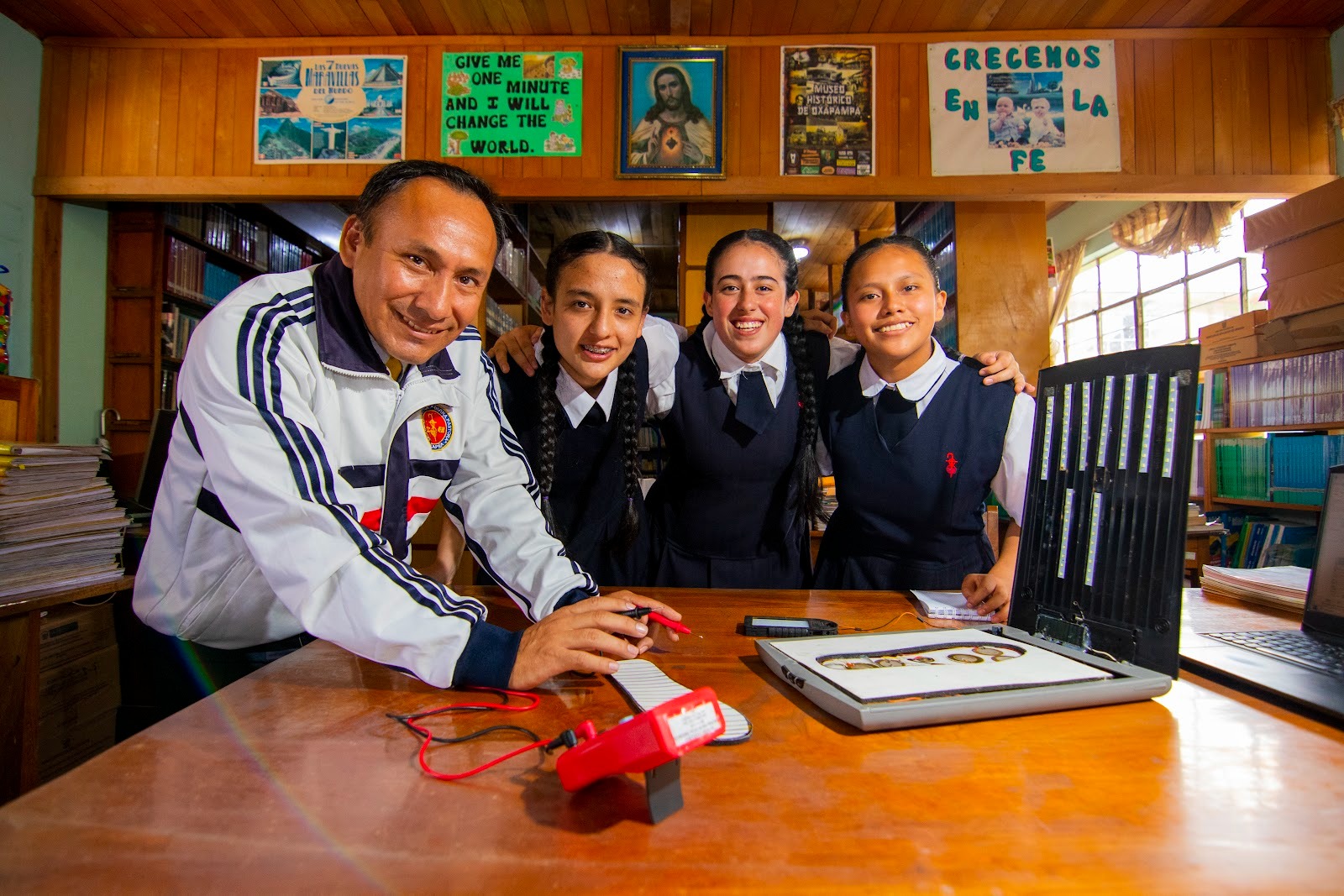
“The STEM approach reduces the excessive amount of abstraction that frequently causes students to shy away from complex subjects. Instead of starting off with formulas, equations, principles and physical laws, it enables the students to explore and get involved with the community’s problems, allows them to come into contact with the issues and be part of the search for technological solutions that can help people who are in situations of vulnerability”, explains Carlos Moya, professor mediator of the Chonta-Tec, finalist of the 2023 edition of Solve for Tomorrow in Peru.
From the teacher’s point of view, this makes it a lot easier to teach exact sciences: mathematics becomes a tool for measuring, estimating and making decisions; physics ceases to be purely theoretical and instead manifests itself in observable phenomena such as vibration, energy or conversion, while chemistry relates to materials, properties and sustainability.
“In this way, the student first understands the ‘why’ of knowledge and it then becomes easier to assimilate the ‘how’ and ‘why’ of equations and laws. STEM does not simplify the contents, but rather puts them in context and reduces cognitive resistance to learning”, declares the teacher , who monitored the design of a sole of a shoe that turns people’s steps into electrical energy.
Educator Gustavo Bezerra, who was the mediator of the Filtropinha project, which won the 2024 edition of Solve for Tomorrow in Brazil, also highlights how STEM projects provide the connection between the subject’s content and the students’ reality. As part of the initiative, chemistry, technology and even administration principles were all used for the creation of a filter made from pine bark to treat cassava liquid , which is a toxic liquid extracted during the production of cassava flour, which is a common product in the region. “If in school they learn about some subject within the discipline of biology or physics, the STEM project demonstrates that this knowledge can be applied outside school. It’s something that can improve the lives of their community.”
Encouraging the STEM approach within schools
Every school is different, and the teaching l project changes based on the territory’s challenges and the municipality’s, state’s or country’s educational policies. In addition, it should be borne in mind that not every school will have laboratories or a technological infrastructure, and that even those educators who teach subjects that compete with STEM, may not be familiar with the Project Based Learning methodology.
In Professor Carlos’ opinion, the adoption of a STEM projects based approach has to be done gradually, starting off with what the school has to offer: “An effective and non-invasive way to introduce the STEM approach is not to present it as a ‘new model’, but rather as a different way of learning the same contents, but with meaning and purpose. The most natural approach is to start off with something that is meaningful to the student context such as energy, electricity, communication, water resources, water, waste, mobility or health. After this you formulate a challenging question instead of presenting a theoretical content.” As an example of the initial question, his suggestion was: How to generate sustainable energy where there is no electricity, from the context?
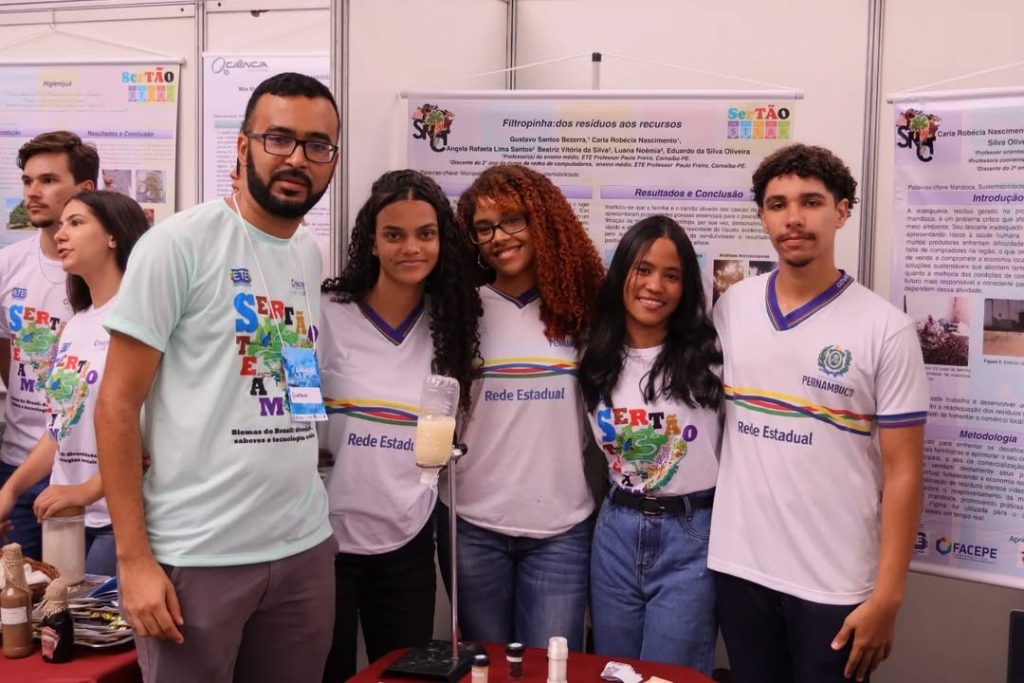
On the practical front, the teacher Bezerra offers two strategies that can transform the way the educational environment views STEM practice: offering students training such as electives or specific STEM courses, makes it possible to form a group of students who may decide to create a project jin the future . “Another alternative comes directly from scientific dissemination. STEM exhibitions and science fairs can lead to increased participation by students and bring about changes that are reflected in schools’ PPP (Political-Pedagogical Project) .”
For both educators, the importance of STEM projects in the school environment lies in what it provides outside of the aforesaid environment . As Carlos Moya recalls regarding the students’ development during the Chonta-Tec project: “The most significant change was not an academic one, but rather one of attitude and perception , as the students stopped focusing just on the test itself and instead wondered whether their solutions worked and how they could improve them. This reinforced the sense of belonging to the project and the feeling of teamwork, and helped boost the students’ resilience in adverse conditions. In our case, physics is no longer just a subject but rather has become a tool for social transformation”.