Loose or disused power and communication cables are a problem in Latin America, where many cities, no matter the size, do not have their buried wiring. In Chiriquí, in Panama, it is possible to observe in the center and in areas of the periphery the dark nests of cables, with some loose or tangled, becoming a danger for people and animals.
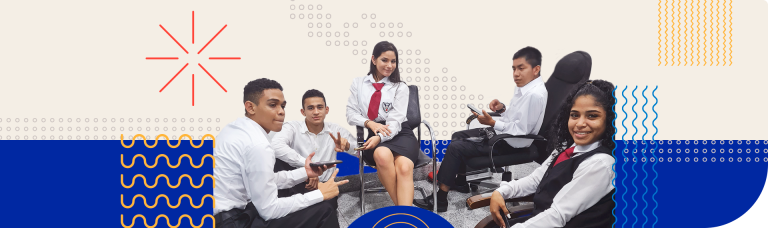
An example of what often happens with loose cables happened in front of the Arnulfo Arias Professional and Technical Institute Madrid, in Chiriquí, Panama. A truck hit low electrical wires, leaving the school without power and internet connection for two days. A group of students observed the serious situation and set out to find a solution: what can be done with technology to improve wiring layout and make maintenance safer?
Thus was born the Cable Guardian, a 2024 finalist project of Solve for Tomorrow Central America and the Caribbean region, which brings together 11 countries: Dominican Republic, Costa Rica, Panama, Guatemala, Honduras, Nicaragua, El Salvador, Ecuador, Venezuela, Belize and Barbados. The prototype consists of a mechanical arm with smart camera and sensor, which detects and removes the cable that is damaged or without power in a safe way, avoiding the contact of people with electric power.
The students are young people who are in their first year of secondary education (in Panama, the educational system consists of Basic Education, Premedia and Media), and with a great willingness to learn, as explained by robotics professor Rafael Montenegro, the team’s mediator: “It was an idea of their own and this surprised me because it is a starting group,” he explained. “I thought that this group, in one or two years, was going to be well prepared, but no. They presented a very good project for the short time they had to do it, and the results are what you saw here,” concluded the professor.
In addition to the joint effort of the students and the teacher, the success of the project is also due to a school that has as its pedagogical vocation to work with STEM (acronym in English for Science, Technology, Engineering and Mathematics). Students, from an early age, have contact with technology subjects and their application to real problems. And teachers, like Rafael, are recognized for taking students to national and international competitions and programs.
A web of opportunities and challenges
But why are there so many loose or tangled wires in the streets? The students began the project with a study on the subject, and found that in addition to the cost of changing yarns, which are made from copper – a valuable metal that can be stolen – maintenance is a dangerous job, which requires many people and safety baggage to remove damaged material.
The four young people’ robótica knowledge of robotics led them to see an arm that could not only detect whether the cables were powered or not, but also pull them off with a computer-controlled clamp. making the maintenance work of electrical and communication companies safer and more controlled.
“The mechanical part of the prototype was quieter, because they already had a lot of experience. We have always worked with robots and mechanical systems, but integrating that part with the software was what took the longest time”, recalls the professor mediator.profesor mediador.
An electromagnetic sensor with a camera was added to the clamp arm in order to identify, by means of images, which cables have no energy or are broken. To achieve this, students had to teach inteligencia artificial (AI) software to do recognition. Much of the work involved photographing hundreds of miles of cables.
“The photos they took were of cables on the street itself, near the school, from their house, where they were. The easiest cables to identify were the cut ones, which were hung. But they also took photos of the tangled wires, to teach AI to automate case identification.
The unfolding future for students
The best thing robotics does is teach students that it’s possible to achieve great things with few tools, explains Montenegro.
Sometimes we look for expensive solutions or we want to look for high technologies for problems that, suddenly, with much simpler devices, or simply by using our heads, we can solve.
It may seem like a quiet job to teach artificial intelligence, but she is made up of human achievements. This process was done manually: the students took different photos, which helped the software to understand and distinguish not only the broken cables, but also avoid identifying the same cable two or three times, since they are similar. Therefore, the students had to label each image taken, meticulously adjusting the software so that it could recognize the differences, avoiding confusion. This adjustment process was performed repetitively, with trial and error, until the system correctly identified each cable according to its characteristics. The group also chose to focus on communication cables, because they receive less maintenance than electrical cables.
The final prototype consisted of: a mechanical arm with clamp that removes damaged cables, a camera attached to software that identifies them and a sensor that detects the existence of electricity. In addition to a battery (which can be recycled, reducing the final cost of the prototype), a robot control system and a site for placing the computer.
For safety reasons and public authorizations, project testing was limited to cables near the school. It took a lot of perseverance to create a more pleasant process in the face of all the information received during the testing phase, as the professor recounts.
“If the system detects a cable, it is activated. But the system detected too many, it was getting too much information and going crazy because he didn’t know what to do,’ explains the professor. To avoid that, they taught the system to view each cable as an ‘event’. When it detects one ‘event’, the system pauses and moves on to the next one, classifying it as another ‘event’, and so separates the information from cables, which have already been seen and those that haven’t yet been. That makes work slower, but also more thorough. “These are things that happen in the experience when you take the prototype system into the field,” Montenegro adds.
But with identification data exceeding 85% success, the project was a success AND for the future students are much more confident that they can improve how the mechanical arm identifies and separates cables. They also hope to achieve testing in public spaces with the approval of electricity companies, to make the project more known, offering the technology as a commercial system for energy and communication companies.
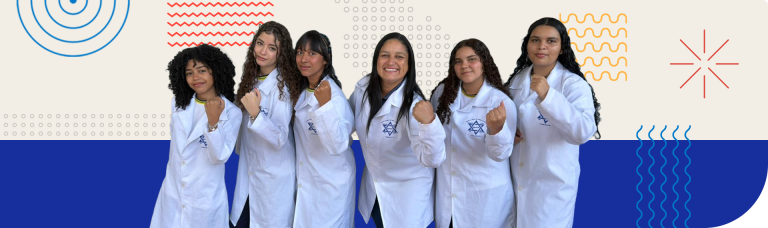
What changed for the four students was their academic future. Robotics, once a school passion, became a career possibility and new horizons. By participating in the Solve for Tomorrow program, the professor envisions national scholarships for them, as was the case with some other students, who won in the past, as well as international travel and study experiences.