Aiquile is a small Bolivian province where life unfolds between mountains, rural communities and rivers. Although it is usually a quiet area, heavy rains and floods have affected agriculture and the lives of the inhabitants in recent years. To anticipate risks, a group of students used STEM (Science, Technology, Engineering and Mathematics) knowledge to create the “AIQUIMET”, a system that integrates IoT (Internet of Things) sensors, artificial intelligence, robotics and computer vision to monitor environmental variables and issue early warnings about climate risks.
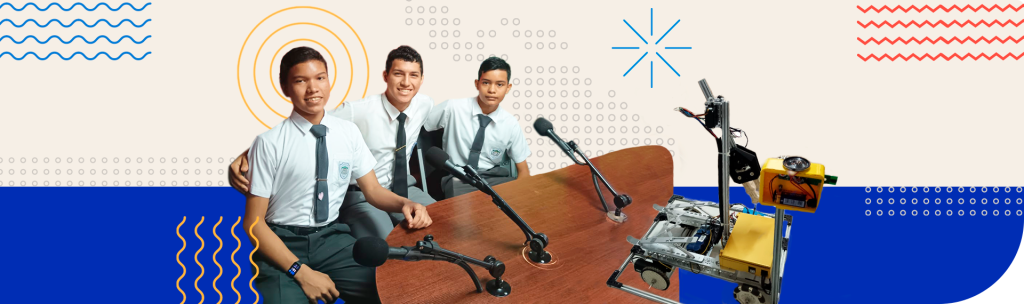
The initiative won Solve for Tomorrow Bolivia in 2025, and was developed by five students aged 15 and 16 in the final years of secondary school. The idea was born in the school’s robotics club, mediated by the Teacher of Computer Systems, Mauricio Ordoñez Carvajal.
The club brings together about 25 students of different grades and age groups; it also serves as a computer and printer repair workshop for the community. “It’s no use just looking at pictures or statistics. The student has to be where the problem is,” advises the teacher.
I teach them to imagine things that don’t exist yet, to think about what we can achieve with the little we have, he summarizes.
So in the Empathy phase of the project journey, young people noticed that one of the main problems affecting daily life in the community were heavy rains and floods, which came without warning, putting families at risk and making it difficult to respond to emergencies. From that reality, students began to talk with local residents , gather information about weather events, and wonder how technology could help anticipate these risks.
The system uses a color code to indicate the level of risk. When the river remains within safe parameters , a green alert is displayed, and only routine monitoring is carried out. If the water level reaches the first established threshold, the system switches to yellow and issues a preemptive alert via an app that people in the community can install on their phones.
When the water exceeds the second critical threshold, red color is activated, which activates the siren, emergency lights and sends notifications for the population to start evacuation.
From the real problem to the solutionThe project took about a year to develop , but the prototype that reached the final stage of Solve for Tomorrow was very different from the first one they imagined.” We couldn’t stay with the first version. Every three months, we had to rethink what could be improved,’ explains Ordoñez. To do this, they analyzed the results, listened to the feedback received and performed new tests before returning to the field.
In the end, AIQUIMET combines the Internet of Things (IoT), artificial intelligence (AI) and robotics to monitor river conditions and issue early warnings when there is a risk of flooding. The system was built using free and affordable tools, making the project scalable and easy to replicate. They used Arduino as the main programming and control platform, as well as electronic sensors connected through IoT technologies, which allow information to be transmitted from rural areas to a monitoring center.
Before building the prototype, the team designed it using Tinkercad (free web application for 3D design, electronics and programming), while image processing and analysis functions were developed with artificial intelligence tools, and OpenCV, an open-source library of computer vision software.
To build the prototype, the students chose acrylic because it is lightweight, durable, water-resistant, and affordable. Inside the structure, they installed sensors and electronic components responsible for measuring, in real time, water level, temperature, humidity and solar radiation. The device was installed and tested in a rural area, approximately 30 minutes from Aiquile, right at the point where the river is born.
In disaster management, every minute counts. By measuring directly at the headwater of the river, the system detects the flood at its source. This gives valuable response time to downstream communities, allowing the alert to arrive before water reaches inhabited or cultivated areas.
When rainfall causes the river level to rise, the sensors detect the increase and the system processes information using artificial intelligence to determine the risk level. When an alert threshold is reached, the prototype sends an alert.
With the assembly ready, they still had to overcome the connectivity challenge. Many of the communities where the system was intended to operate lack internet access and telecommunications infrastructure. To solve this problem, the students researched radio frequency systems and developed a point-to-point wireless network capable of transmitting information between different communities.
This network was inspired by a bee swarm: several relay stations were installed between the river and the community, so that each station receives the signal and retransmits it to the next until reaching the monitoring center located in the village. We knew judges would ask not only how the device worked but how it was going to communicate with others. So we researched far beyond the Arduino”, added the teacher.
Once the information reaches the community, the system can send SMS messages, mobile app notifications and radio alerts, allowing families to receive early warning and prepare for a potential flood.
Powered by solar energy, the system was designed to operate even in rural areas with limited infrastructure.
“We learned a lot there,” recalls Ordoñez. “Everything worked in the lab, but when we brought the project closer to reality, problems appeared that we hadn’t seen.” With this new stage in the process, the new tests revealed opportunities for improvement: reinforcing the structure, recalibrating sensors, measuring water velocity, and defining the time needed to trigger alerts before the river reached dangerous levels.” If it rained, it was an opportunity to try. If we found a problem, it meant that we could still improve.”
In the water pump tests, the final criterion was based not only on water level but also on the response time available to the community . In the prototype under ideal conditions, the alert should be activated 2 minutes before the water reached the critical level. This difference is equivalent, in a real situation, to about 30 minutes in advance, thanks to the network of stations that relay the signal from the monitoring point to the community.
Diversity, collaboration and project leadership
From the beginning, the Teacher was clear that “AIQUIMET” needed a diverse team. So he sought to bring together students with complementary skills, without replicating the gender barriers that still often exist in STEM fields. “I want my students to understand that everyone can contribute equally and that talent does not depend on whether you are a man or a woman,” he emphasizes.
Until that time, each member independently developed projects within the robotics club. The teacher knew each student’s strengths well from years of working together and decided to bring them together when he felt they had reached maturity for a larger challenge. He selected the five participants taking into account gender diversity and the variety of skills.” I saw that each student had different abilities. So I thought, “I’m going to make a good team. Each one had something special to contribute.”
Each student took on a role according to their interests. One took care of the graphic design and visual identity of the project; another investigated water quality and its implications for health; a student focused on the design of electronic circuits; and another member specialized in the telecommunications needed to transmit data from areas without internet access. But reaching that level of coordination was not immediate.
More than a project: to train young people who inspire others
For Ordoñez, the greatest achievement of “AIQUIMET” was to transform the way its students see their own potential. “When they have experiences like Solve for Tomorrow, they come back with a different way of thinking. All that they learn from juries and from everything they experience . They become a much larger support within the school,’ he says.
This change is visible both inside and outside the classroom. Students who were once shy begin to speak in public confidently, lead teams and help teach others. ” They develop a much more open mindset that even helps them in other subjects,’ he adds.
After all, for the teacher, STEM knowledge serves to open new paths for students and equip them with socio-emotional and technological skills that they can carry with them throughout their lives. “I am interested that the students come prepared and that they are able to face tomorrow, in a better future,” he concluded. After “AIQUIMET”, the students were motivated to continue on this path: three members now study Systems Engineering at the university, while two continued to attend the final year of high school and continued to participate in the robotics club.