Can you imagine that every time you served lunch, a third of the meal was left over and went into the trash? Surely, many Latin American girls and boys would be reprimanded by their mothers for so much food waste, wouldn’t they? But that is what is happening globally. The Food and Agriculture Organization of the United Nations estimates that one-third of what is produced on the planet is lost every year, with environmental and social impacts, involving all stages of the chain, from production to consumption. What if there was a way to connect restaurants with surplus food and people interested in taking it out?
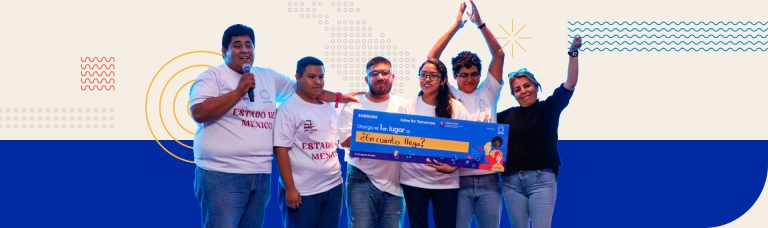
Thus arises “Food Loop”, a platform created by students that helps reduce food waste through a technological solution. The project was a finalist of Solve for Tomorrow Argentina, in 2025, and was developed by five young people in the second-last year of compulsory schooling, aged 16 and 17 years old, from the municipality of Córdoba.
According to the mediator teacher, David Müller, the idea was built from an observation of students in bakeries, restaurants and other places, where a part of daily production is not sold and ends up being discarded. “At the same time, there is a demand for more affordable options to access food,” he adds.
Then, the “Food Loop” functions as a system for publishing and searching available foods, like how delivery apps work. Restaurants upload information about the products they failed to sell, including description, portion quantity and location. From this data, users can identify nearby options and coordinate their withdrawal. Food is donated as a corporate social responsibility (CSR) action, and it lowers its operating costs by reducing the number of kilograms of waste they throw out – in the city of Córdoba, large garbage generators are charged per kilogram of waste generated.
The importance of having allies in school
To develop this project, the students were divided into roles typical of the professional world, with work in front-end (graphical interface of the project, the part that the user accesses) and operating logic. They used free programming tools, such as React, an open source library focused on creating user interfaces for web pages.
Professor David Müller is an industrial designer, with a master’s degree in Business Management. About ten years ago, he entered school teaching gradually: he started teaching in the technological area and then also assumed management and teacher training functions.
Although he does not come from the programming area, in the “Food Loop” project he made progress thanks to the collaborative work with the school’s programming teachers, who contributed the necessary technical knowledge for the digital development part. “The key is to take these methodologies and adapt them to the reality of each school, with the resources you have,” believes the teacher.
The “Food Loop” was built under a Project Based Learning logic. The students went through different stages, from identifying the problem to building a working prototype. For validation, it was once again important to have support from the school community. In the school, it is a common practice to have an internal instance with students of one year higher, specialized in software testing.
“So, the sixth-grade [last year of compulsory schooling] students tested the fifth-grade boys’ program, who were the ones who developed it. There they found several mistakes, which were patching and settling,” he explains. The exchange allowed them to adjust technical aspects and improve user experience.
This kind of experience shows them that, if they take it seriously, they can make real change and not just do schoolwork, the teacher says.
People-centered technology
This process with potential users allowed them to understand the complexity of the problem and learn how to improve the solution continuously from validation. “The biggest challenge was not to lose focus on the user. The important thing was to understand the problem, the solution and who they were helping. If before they thought more about the technical solution, now they think about the person,” says Müller.
The entire process took place over a period of approximately four to five months, with an intensification of work in the final stages, where instances of mentorship and continuous review were added. “The Solve for Tomorrow training sessions really brought value and generated new learning dynamically,” he evaluates.
According to him, the project also generated more interest in other students, who began to consider this type of initiative as a concrete possibility. The experience reinforced the idea that it is possible to develop competitive solutions from the school level, as long as there is support and a clear methodology.
“The children saw firsthand the realities and problems of other places, which perhaps they were not used to. That allowed them to open their heads to a lot of situations happening around them,” the professor says.
Beyond that, the experience represented an important formative challenge, since they were encouraged to work with greater rigor, commitment and organization, understanding their productions as if it were a real professional environment.