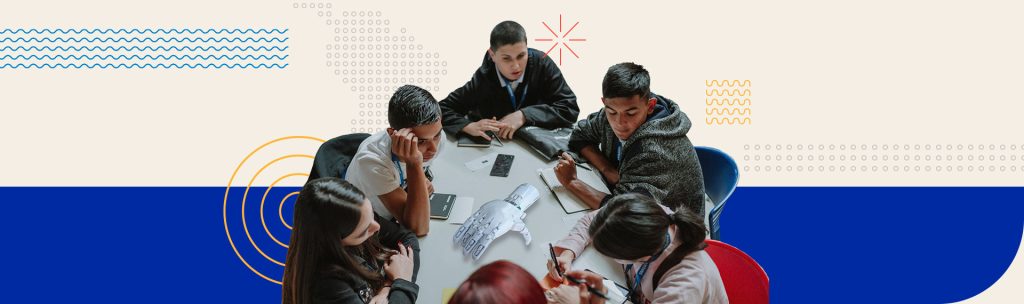
Waste is a global problem, but it affects different communities in different ways. When there is no proper waste management in public containers, the waste overflows and becomes a public health problem. A team of students in Tegucigalpa, Honduras, asked the following question: how can technology help with waste management both at home and on the streets, and how can this prototype meet the challenges both of their territory as well as those of other countries; how to make it an exportable idea?
A smart dumpster, which is able to communicate with the user when it is full and thus optimize the waste collection route, was the winning project of Solve for Tomorrow Honduras 2024 Central America and the Caribbean. The “Intelligent Waste Management System (IRMS)” project consists of a set of sensors which, when attached to a household dumpster or container, send a notification to a mobile application when it is time for collection.
A team of computer science teachers invited the final year students doing a High School Diploma in IT at the Instituto Gubernamental España Jesús Milla Selva to develop projects that transform their local reality. One of the young students observed that waste management is a problem in Honduras, and suggested that the team use robotics as a focus of the challenge.
This was the second time that mediator teacher Luis Orlando Irias Galeano participated in the Solve for Tomorrow initiative. For him, what made the difference in concluding the project successfully was not only the students’ original idea, but also their ability to build partnerships that drove the project’s development.
Big ideas, prototype possible
The ideation process started off in an ambitious way: the students wanted to create a community waste management system. However, during the research phase, and bearing in mind the amount of time available for the project’s development , they realized that the most feasible option was to adjust its scope and work on a prototype that would replicate public road conditions, using waste generated at the school.
Thanks to their computer skills, the team chose to work with sensors that could perform two functions: identify the amount of garbage and send a signal, via Bluetooth, to a mobile application. “We use proximity sensors, a Bluetooth module, an Arduino board and a free mobile app,” recalls Galeano when listing the materials used.
The dumpster selected for the development of the prototype – which eventually became the final version – had a lid. In this way, the proximity sensor was placed close to it, which made it possible to detect the amount of residue according to the millimeters of aperture. “We filled the dumpster with shirts and other materials available so that, when the lid was lowered, the system determined it was full; then we removed the contents to indicate that it was empty,” explains the teacher.
The robotics stage, that is, the commissioning of sensors, was not without its frustrations. The first sensors used did not respond correctly, leading the team to think that they had been damaged, especially because they were uneconomical. It was necessary to get assistance from an external instructor, who identified that the problem was not in the sensors but in the application, which did not work properly on a newer version of Android. By using a phone with an earlier version of the operating system, they were able to make the prototype work and could carry out measurement tests.
For this reason, the teacher stresses the importance of establishing partnerships aimed at strengthening the project: “It is necessary to seek support, because we do not own knowledge; in fact, we know a lot less than we think we do. Not all students’ ideas fall within our area of expertise and we do not always have the necessary experience. During the final stages, when a prototype is to be built and presented, it is very valuable for young people to get feedback from outsiders. When they interact with specialists and other professionals, they feel that they are part of something different and this keeps them motivated”.
An ending that proved it was possible
Although the team failed to develop a complete system for street waste management, the final prototype received the award for demonstrating the idea’s potential and the students’ commitment to the initiative. For Galeano, the main thing learnt was for the young people to realize that they could win a competition using their own knowledge and resources.
“I think the most significant thing learnt was that they realized they could go a long way. Initially they simply did not believe it; you could see it on their faces that they thought it was impossible. Then they met teams from other countries who had also won, just like them. They were just an average group of students, in a normal stage of adolescence, with some of them being close to the borderline between passing and failing. Once they realized that they could do important things it really motivated them,” says the teacher.
A team of dedicated teachers and volunteers made a decisive difference in the project’s development . Therefore, it is essential for the teacher not to work in isolation and that the school should promote collaborative spaces between teachers to support students in developing STEM projects. Now, a lot of the young people involved are already on track to go to university, many of them in technology-related areas, and the teachers are confident that only via a school community culture can innovative solutions be generated.