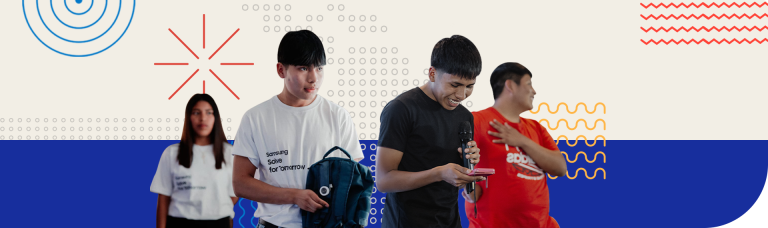
In the face of climate change, inaccurate traditional weather data and out-of-season rainfall have wreaked havoc on Costa Rican farmers. To address these challenges, a team of students has developed a low-cost tool powered by artificial intelligence (AI) to predict the weather and protect smallholder farmers’ crops. The technology promotes food sovereignty, climate resilience, rural justice, seeking to restore control over their production.
The “AgroTico Smart” project won the Solve for Tomorrow in Central America and the Caribbean region in 2025. The initiative emerged in response to environmental challenges affecting smallholder farmers, a group highly exposed and vulnerable to such impacts. To combat this uncertainty, the device created by students analyzes the earth using sensors of humidity, temperature, oxygenation and solar radiation. This environmental data is combined with predictive AI models and satellite data to provide an accurate picture of local conditions.
The collected data is presented into easy-to-interpret charts through a mobile application designed to work even in agricultural areas with limited connectivity. This allows farmers to receive real-time information about the best times to plant, irrigate, or protect their crops. In addition, to ensure that the solution is economically viable, young people built the prototype using digital modeling, 3D printing, and low-cost electronic components.
The students were 18 years old and in the last two years of their technical education. In Costa Rica, technical college programs last six years, with the final year dedicated to supervised practical training, during which students work at a company to apply the technical skills they have learned. As a result, time management was one of the biggest challenges they faced while continuing to develop the project.
The young people were studying Industrial Electronics, Computer Science in Web Development and Precision Mechanics. Their school also serves vulnerable populations through social development initiatives, and has a Center for Innovation and Research for Learning. “It is a space that encourages the development of technical skills, with the STEM (Science, Technology, Engineering and Mathematics) methodology and with collaborative groups among students. It’s where students come together to develop interdisciplinary projects,” explains project mediator teacher Jeisson Córdoba, who acts as a technology development mentor in the school.
First, the students developed a project called “Agrotech”, focused on precision agriculture.”It served as a starting point for them to realize their potential as students and see how they could connect a new project to Solve for Tomorrow,” explained the teacher. The young people built a very low-cost first version, with simpler microcontrollers and sensors. The goal was to check if the prototype was functional. With that prototype, they won the Solve for Tomorrow program in Costa Rica.
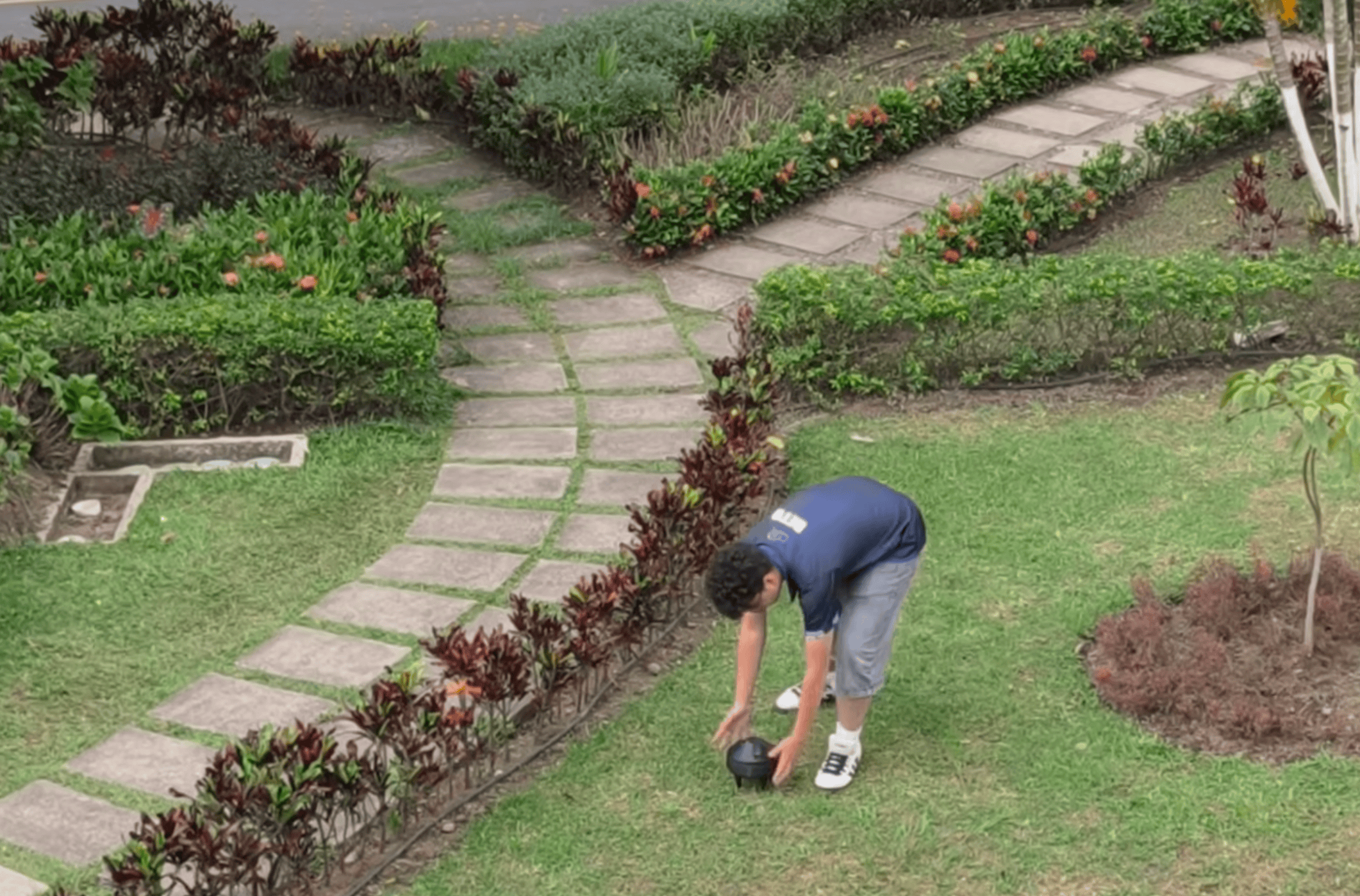
“However,they were not entirely satisfied with the product and decided to start over, preparing a new version for the regional stage of the program”, reports the educator. Well, they bought new sensors, more powerful ones, and tested them in three environments, using geolocation to refine the results and scope of the prototype. “The school is located on a mountain, so there were many areas available for testing the sensors at different altitudes,” describes Córdoba. The students also tested the prototype in the area of Turrialba, where they had access to a farm.
The result was a device capable of providing real-time information such as humidity and temperature, along with more reliable weather forecasts, so that the farmer could determine when to grow, when to water, and how to protect his crops. The device can be placed in the field and the farmer can access data via an app, no matter where he is located, as long as there is an internet connection in the area where the robot is installed.
The team’s organization and family support made a difference
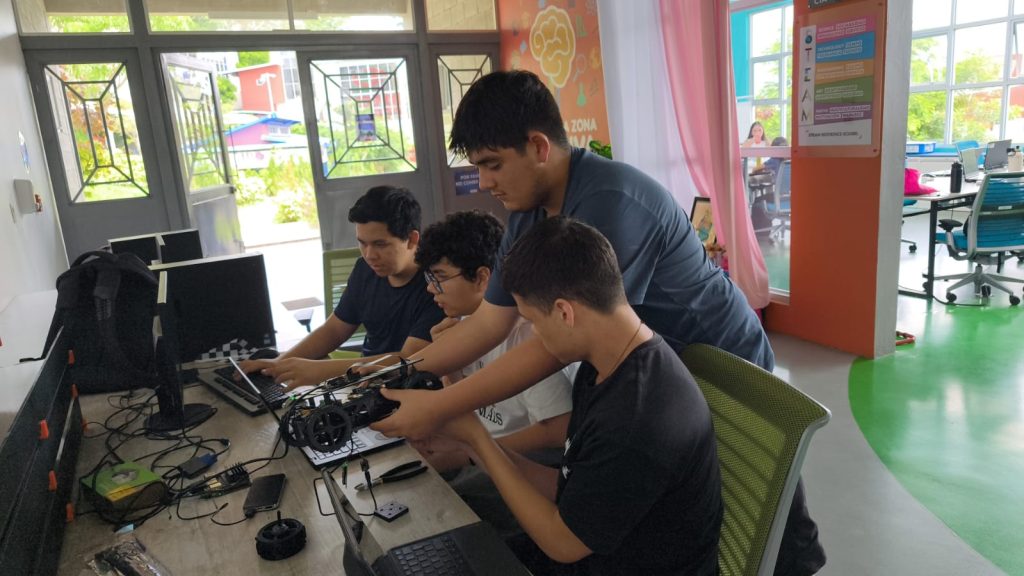
Tasks were distributed according to each member’s technical skills. The precision mechanics student, for example, took charge of designing and manufacturing the structure. His experience with digital modeling, 3D printing, and materials software allowed him to lead the hardware development. The two Industrial Electronics students handled the sensors, printed circuit boards (PCBs), connections, and microcontroller programming.
The software development was handled by another member, with special interest in new technologies. For the project, he trained an artificial intelligence model with data that enabled indicators of climate change in the region, including satellite data. He also developed the connection between the web platform, data processing and the interface that the farmer would use.
“In the end, a team was formed that even looked like a family,” says the teacher. The students set weekly goals and continued working even when they had classes or needed to travel. On occasion, they would leave the files ready for the teacher to supervise 3D printing while they were away from school.
Their families also played an important role in supporting their commitment. The students used to stay at the school until eight o’clock in the evening, although classes ended at half past four. Their parents would pick them up and, in some cases, arrange meals so that they could continue working. “When it was time for the trip, their parents even went to drop off the students at the airport, just as they welcomed them when they returned. Over there, they had champion banners and everything. So, that part was very nice too,” adds the teacher.
The project taught students to ask for help when they needed it and to understand that mistakes are part of the process, that you have to keep trying, see things from other perspectives and make adjustments until the end, says teacher Jeisson Córdoba.
One of the team’s goals was also to achieve IP69K certification, related to dust and water protection in harsh conditions. The sensors presented another challenge. During testing, some produced inconsistent readings even in the same location, prompting the team to look for more reliable alternatives. Rather than keeping the original components, they opted for sensors from specific manufacturers that offered greater reliability and made integration between components easier.
The decision also took future users into account. “If a farmer ever had a problem with a sensor, install a new one, and plug it in. It would work right away,” the teacher explains.
The team still had to make the integration between the physical components and the computing platform work, not only measuring variables using sensors but also sending the data to a server, storing it in a database and retrieving it for processing in the software.
To make this possible, the school facilitated access to a remote server located in the US. Using this infrastructure, the students developed the necessary connections so that the information collected by the device could reach the platform. “That part of connecting electronics with data was something very new for everyone,” the teacher says. Throughout the project, the team worked through these challenges by combining knowledge of mechanics, electronics, programming and data analysis.
The STEM project brought learning to the entire team, including the teacher
Although he already had certifications and technical expertise, the development of the prototype required the teacher to learn new tools and participate directly in tasks ranging from programming to electronic connections and welding. “Every time we develop a project, the students have a lot to teach us,” says the teacher.
Beyond the project’s results, the educator emphasizes that the experience changed how students approach challenges. For example, for the regional grand finale of Solve for Tomorrow, the team traveled to Panama to present their project. Upon arriving, they tried to test the prototype, but it did not work. At first, they thought the problem was an internet connection or IP address (a number that functions as a network mailing address). “We thought it couldn’t be that we had traveled so far only for it not to work, when it had worked perfectly back home” recounts the educator.
They checked the sensors, disconnected components, and looked for potential faults until, during a test night, they found the solution: just change the country configuration. The microcontroller was configured for Costa Rica, when it was to operate in Panama. “It was literally a click to switch to another country,” the mediator recalls. They discovered the problem just in time, after hours of uncertainty and rehearsals that lasted until dawn. Although nerves lingered until the presentation, they learned to turn them into motivation to do their best.
For the teacher, preparing the pitch was one of the most valuable learning moments for the students. ‘Technically, they were very good, but they had a lot of difficulty speaking in front of an audience. So we worked on that and, I think it was a wonderful experience, that even I grew a lot in being able to communicate ideas,’ says Córdoba.
They trained a lot and came to create a social media profile for the project, and now record videos with complete confidence. “You can’t imagine that they used to be so shy,” says Córdoba.
These communication skills proved valuable later, when the team was recognized as a Solve for Tomorrow winner. Upon returning to Costa Rica, they had the opportunity to have lunch with ambassadors and give interviews to the press. “They gained more than technical knowledge from this experience. They also developed soft skills that will serve them throughout their lives,” the teacher adds.
Now, three of the four students in the group are at university, studying mechatronics and software engineering. “They chose different fields, but always closely related to the impact this project had on life,” says the teacher proudly.